

The hidden cost of HR work living in spreadsheets, inboxes, and PDFs
Authored by: Blake Smith
Most organisations do not choose to run HR this way. It simply happens.
A spreadsheet becomes the employee register.
An inbox becomes the approval workflow.
A folder of PDFs becomes the record of truth.
None of these tools are broken on their own. The problem is what happens when they quietly become the system.
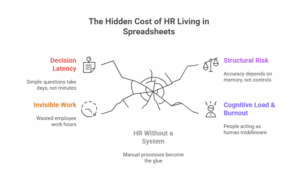
From the outside, spreadsheet-driven HR looks efficient. It feels lightweight and flexible. It avoids the cost and disruption of implementing software. But from a distance of working with hundreds of Australian businesses, I have seen a consistent pattern. The real cost of this setup does not show up in line items. It shows up in lost time, delayed decisions, avoidable compliance risk, and burnout across teams that were never meant to operate as human middleware.
The invisible work no one budgets for
When HR information lives across spreadsheets, inboxes, and shared drives, work multiplies quietly.
Small tasks begin to stack.
• Updating the same employee detail in three places
• Searching email threads to confirm approvals
• Reconciling different versions of the same document
• Rechecking information because there is no single source of truth
None of this work improves outcomes for employees or the business. It simply keeps things from breaking.
Over time, this creates a drag on the entire organisation. Hours are spent maintaining consistency rather than improving processes. HR teams become custodians of information rather than enablers of people strategy.
“The most expensive HR work is the work that exists only because systems do not talk to each other.”
When flexibility turns into fragility
Spreadsheets feel flexible because they do not enforce rules. That freedom is appealing early on. But flexibility without structure becomes fragility at scale.
Spreadsheets do not understand context. PDFs cannot validate accuracy.
As headcount grows, complexity grows faster.
Different employment types. Different awards. Different entitlements. Different compliance obligations. Managing these relationships manually means accuracy depends on memory, personal vigilance, and heroic effort. That is not a control system. It is a risk model.
The danger is not that mistakes happen. It is that they often go unnoticed until they are costly.
Decision latency is a hidden tax on leadership
Fragmented HR data slows decisions in subtle ways.
Simple questions take longer to answer.
- Is this contract current?
- Has this training been completed?
- Are we exposed if we proceed?
When answers require cross-checking multiple files and inboxes, leaders hesitate. Decisions are delayed or made with incomplete information. Over time, this erodes confidence in the data itself and creates a culture of second-guessing.
Speed matters. Not for the sake of urgency, but for clarity. Systems that centralise HR information reduce cognitive load and allow leaders to act with confidence.
Employees feel the friction even if they cannot see it
Employees do not care where HR data lives. They only experience the outcomes.
Delayed responses. Conflicting answers. Repeated requests for the same documents.
These moments rarely trigger formal complaints. Instead, they quietly shape perception. Over time, they signal disorganisation, even when the underlying issue is tooling rather than intent.
Employee experience is often discussed in terms of benefits and culture. But consistency and responsiveness matter just as much.
This is not an HR failure. It is a systems issue
It is worth being clear about what this is not. This is not a capability problem or lack of skill from staff.
In most cases, HR teams are doing exceptional work with the tools they inherited. The issue is structural. We would not expect finance to close the books through email and spreadsheets alone. HR now carries similar governance and compliance responsibilities and deserves systems designed for that reality.
HR software provides the structure that spreadsheets and inboxes cannot, turning fragmented processes into governed, auditable workflows.
Removing work is the real upgrade
From a commercial perspective, the shift away from spreadsheets is rarely about features. It is about removing work that should not exist in the first place.
The hours spent reconciling data.
The stress of last-minute checks.
The reliance on individual memory to stay compliant.
Progress does not come from doing more HR work. It comes from designing systems where less manual intervention is required.
Spreadsheets, inboxes, and PDFs will always have a place. The mistake is asking them to carry the weight of an HR system they were never built to be.
Author Bio: Blake Smith, Marketing Manager, ClockOn
