Written by Ashley Gibson
Every HR leader knows the number. It shows up in the retention dashboard, the exit interview summary, the engagement survey nobody fills out honestly. Burnout. Turnover. Disengagement. Whatever the label, HR is the department that reports it, explains it in the leadership meeting, and is expected to fix it.
There’s a structural problem embedded in that expectation, because the number HR is asked to move is almost never produced by anything HR controls.
Burnout originates upstream, in decisions about staffing ratios, deadline structures, who holds decision rights, whose calendar absorbs the slack when a plan changes. Those decisions sit with operations and leadership. The output lands on HR’s desk as a retention problem.
The pattern, not the person
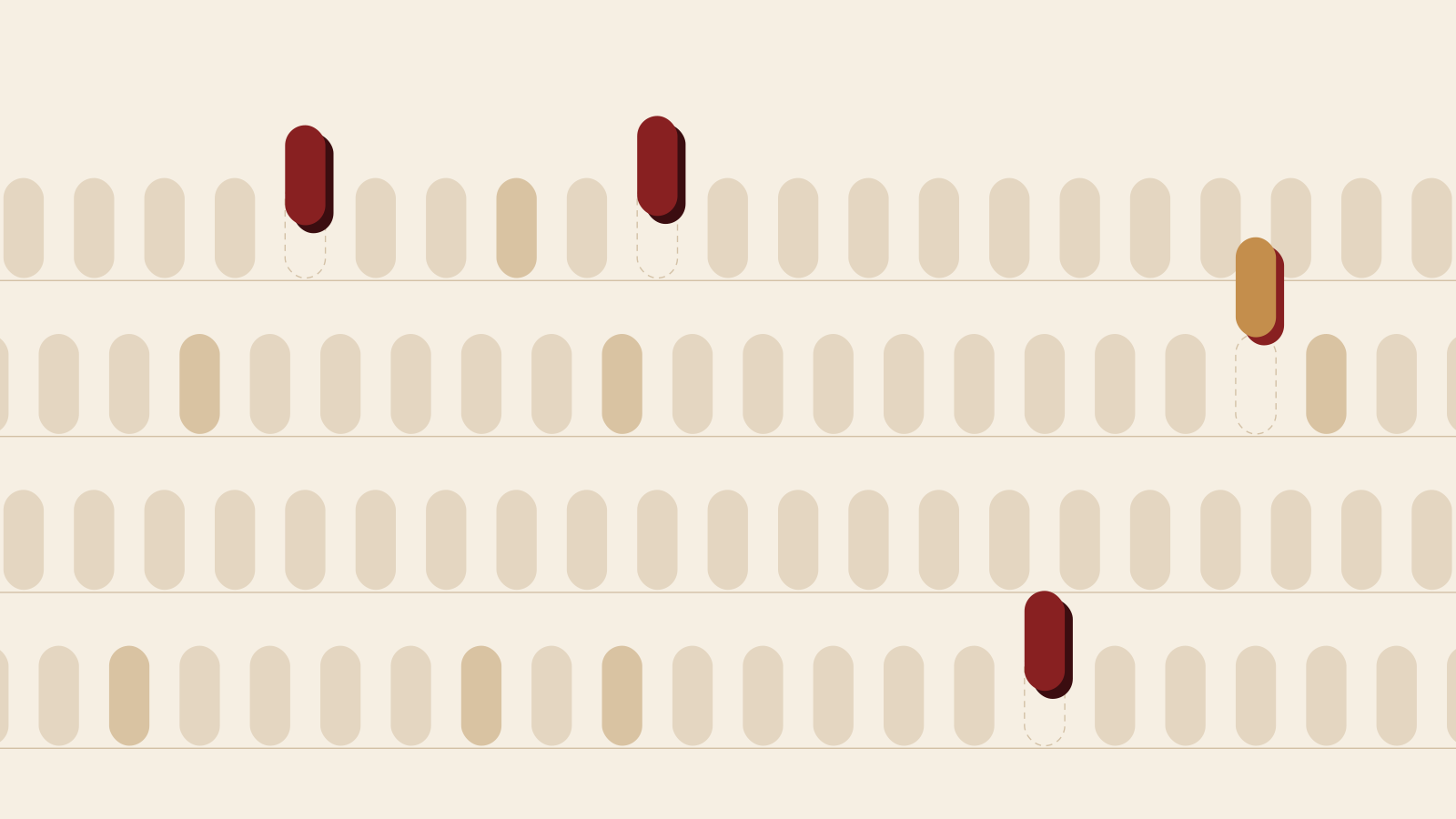
Organizations don’t set out to burn people out. What happens instead is less dramatic and more mechanical: a pattern of urgency, overfunctioning, or unclear ownership gets modeled at the top of a team, and it gets copied down through it. A manager who watched their own leader treat every deadline as a crisis will run their team the same way, not out of malice, but because that’s the only model of “how we operate here” that they were given. The team absorbs it. Eventually someone leaves and the exit interview cites burnout, workload, or “just needed a change.”
That exit interview reaches HR as an individual data point. But what it’s actually reporting is the output of a pattern that started somewhere else entirely and reliably produces the same result every time it repeats.
This is the core problem with treating burnout as an HR metric: HR is positioned as the owner of an outcome without being given authority over the mechanism that generates it.
What this costs HR
Two things happen when burnout is treated purely as an HR-owned metric.
First, HR ends up managing the symptom in a loop that they can’t resolve. Engagement surveys get run, action plans get written, wellness benefits get expanded, and the number moves briefly, if at all, because none of those interventions touch the upstream pattern producing the exhaustion in the first place.
Second, HR absorbs the credibility cost. When the number doesn’t move, the read internally is often that HR’s programs aren’t working. But in actuality, your HR department was never handed the lever that would move it.
Reframing the mandate: from owning the outcome to tracing the pattern
The more useful role for HR isn’t as outcome owner.
Your HR team should function as a diagnostician. That means treating retention data, exit interviews, and engagement scores not as a report card on HR’s programming, but as evidence in a chain that needs to be traced backward.
When a team shows a spike in attrition, the question worth asking is “What pattern is this team’s leadership modeling, and where did that leader learn it?” Burnout that clusters under a specific manager, project structure, or workflow is almost always telling you where the pattern started, if someone is willing to trace it that far back instead of stopping at the individual who left.
Practically, this looks like:
- Presenting turnover and engagement data to leadership as diagnostic evidence of an upstream pattern, not as a performance metric HR is behind on.
- Asking where a concerning pattern is modeled before asking how to fix it downstream. A pattern that shows up in three different teams under three different managers usually traces back to something structural above all three.
- Building HR’s seat at the table around pattern-tracing authority, not just program delivery. That’s a different ask than a bigger wellness budget, but it’s the one that’s more likely to change the number.
The reframe leadership needs to hear too
None of this lets leadership off the hook, but naming a pattern isn’t the same as naming a villain. Most leaders modeling unsustainable urgency inherited it from somewhere themselves. It was never intentional, but it is traceable. The organizational conversation that needs to happen isn’t “Who is responsible for this exhaustion?” Instead, we should be asking “What structure is producing it, predictably – no matter who sits in the roles?”
HR is often the only function with visibility into the pattern across the whole organization: the exit data, the engagement scores, the manager-by-manager variance. That visibility is worth more as diagnostic intelligence than as a scorecard that HR is expected to improve…without the authority to touch what’s generating the number in the first place.
The number will keep showing up on HR’s desk either way.
Author Bio: Ashley Gibson is a psychotherapist and organizational strategist who studies why good people burn out inside good organizations. She got her start on the original marketing team for Broadway’s Hamilton — before it was Hamilton — and spent over a decade in high-stakes arts and nonprofit leadership before training as a clinician. Drawing on both, she developed MOCP (Maladaptive Organizational Copy Processes) to explain how burnout gets encoded into an organization’s relational patterns long before it surfaces as attrition or turnover.
Through Meaning in Practice, she works with healthcare and corporate leaders to diagnose those patterns before they cost them their best people. She teaches “Strategic, Sustainable, and Values-Aligned Leadership” at the University of Richmond’s Impact Institute, speaks for organizations including the Organizational Development Network and Professional Women in Healthcare, and is a frequent podcast guest on leadership and workplace culture.
Her white paper on structural burnout, Maladaptive Organizational Copy Processes: A SASB-Based Framework for Diagnosing Structural Burnout in Organizations, will be published in September 2026. She also writes The Foundry, a Substack series of dialogues with systems thinkers on why well-intentioned systems keep reproducing outcomes nobody wants.